
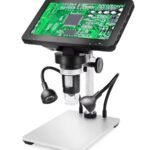
Binocular Microscope (1600x)
Classic binocular compound microscope with 40x-1600x magnification — the reliable, classroom-proven workhorse for botany, microbiology and seed pathology labs.
₨50,000.00
-
Pick up from the Woodmart Store
To pick up today
Free
-
Courier delivery
Our courier will deliver to the specified address
2-3 Days
Free
-
DHL Courier delivery
DHL courier will deliver to the specified address
2-3 Days
Free
-
Warranty 1 year
-
Free 30-Day returns

Payment Methods:
Description
A binocular microscope is the classic compound microscope with a two-eyepiece viewing head, giving 40x to 1600x magnification of prepared slides — the standard instrument for observing plant cells, leaf sections, pollen grains, bacteria smears, blood cells and pathogens.
For Pakistani universities, agriculture colleges and seed companies, the binocular microscope is the backbone of every botany, microbiology and pathology practical. Seed companies use it for pollen viability checks, seed-borne pathogen examination and plant tissue inspection; diagnostic labs use it for routine smears.
Medium-tier models like the widely used XSZ-107 series combine genuinely good optics with prices Pakistani institutions can buy in quantity. Binocular heads reduce eye strain during long teaching sessions compared to monocular models — a real comfort advantage in a busy lab.
A typical package includes the microscope body with binocular head, two eyepiece pairs (WF10x, WF16x), four objectives, mechanical stage, immersion oil bottle, dust cover, spare halogen bulb (if halogen model) and manual. Protective case may be included or optional.
This product is for university and college biology/botany labs, agriculture university pathology departments, seed company QC labs, hospital and diagnostic laboratories, and food testing labs doing routine microscopy.
Key Features
- 40x to 1600x total magnification — ideal for teaching and routine diagnostics
- Sliding binocular head (45 degree inclined, 360 degree rotatable) for comfortable two-eye viewing
- 4 achromatic objectives: 4x, 10x, 40x (spring) and 100x (spring, oil immersion)
- Wide-field WF10x and WF16x eyepiece pairs
- Double-layer mechanical stage (approx. 140 x 130 mm) with coaxial X-Y controls
- NA 1.25 Abbe condenser with iris diaphragm for sharp contrast control
- Coaxial coarse and fine focusing (fine precision 0.002 mm)
- Adjustable halogen or LED illumination with brightness control
- Sturdy all-metal body built for years of classroom and lab use
Specifications
| condenser | NA 1.25 Abbe with iris diaphragm and filter |
|---|---|
| dimensions | Approx. 220 x 205 x 390 mm |
| eyepieces | WF10x and WF16x (pairs) |
| focus | Coaxial coarse + fine, 0.002 mm precision |
| illumination | 6V/20W halogen or LED, adjustable |
| magnification | 40x – 1600x |
| objectives | 4x, 10x, 40x(S), 100x(S, oil) achromatic |
| power | AC 220 V / 50 Hz |
| stage | 140 x 130 mm mechanical, 75 x 45 mm travel |
| viewing_head | Sliding binocular, 45 deg inclined, 360 deg rotatable |
How to Use
- Place the microscope on a stable, vibration-free bench and connect the power supply.
- Start with the lowest-power (4x) objective and lower the stage before inserting a slide.
- Place the prepared slide on the mechanical stage and secure it with the clips.
- Use the coarse focus knob to bring the specimen into view, then refine with fine focus.
- Move up to higher objectives (10x, 40x) refocusing finely at each step; use immersion oil only with the 100x objective.
- Adjust the light intensity and iris diaphragm for best contrast on each specimen.
- Switch off the lamp and lower the stage before removing slides.
- Cover the microscope with its dust cover after every session; clean lenses only with lens paper and lens cleaner.

Reviews
Clear filtersThere are no reviews yet.