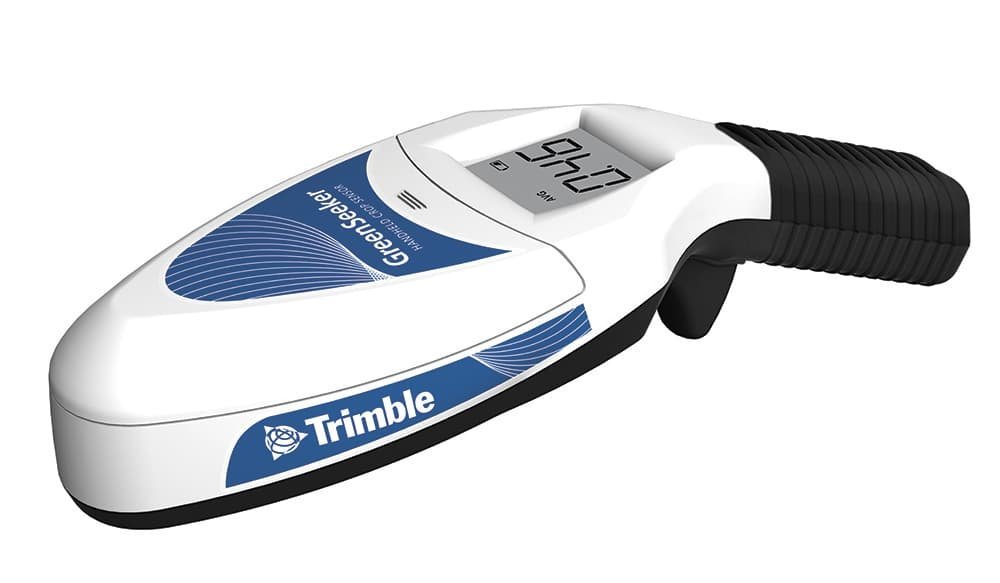
A handheld NDVI crop health sensor is a small, gun-shaped optical device that measures how vigorously your crop is growing. You hold it over the plant, pull the trigger, and it emits brief bursts of red and infrared light, then measures how much of each is reflected back. That ratio is displayed instantly as an NDVI reading from 0.00 to 0.99 — the higher the number, the healthier and more vigorous the plant. It works in any daylight, needs no calibration strips in the field, and records readings you can review later.
For farmers in Punjab, Sindh and KP, this solves one of the most expensive guessing games in farming: how much urea or DAP to apply. Across Pakistan’s wheat, maize, sugarcane and cotton belt, fertilizer is routinely over-applied — costing tens of thousands of rupees per acre per season while degrading soil. An NDVI reading lets you compare different patches of the same field against each other (for example against a small well-fertilized reference strip), so you apply nitrogen only where the crop actually needs it. Research-backed nitrogen management programs in South Asia have repeatedly shown input savings of 15–30% with no yield penalty.
The biggest practical benefit is speed and objectivity. A field manager can walk a 25-acre wheat field and take 40–50 readings in under an hour — far faster and more reliable than eyeballing yellowing leaves. Because the sensor uses its own light source rather than sunlight, readings are consistent whether it is morning or midday, clear or overcast. Data can be logged via Bluetooth to a smartphone app, so readings from different weeks can be compared to track whether the crop is responding to the fertilizer you already applied.
A typical package includes the handheld sensor unit with LCD display, a rechargeable lithium-ion battery and charger with universal plugs, a USB cable, wrist strap, carry pouch and a quick-reference card explaining how to interpret readings. Bluetooth connectivity to a mobile app for data logging is standard on current models. No external software license or subscription is required to use the device.
This tool is ideal for progressive growers (wheat, maize, rice, cotton, sugarcane, potatoes), farm managers handling multiple plots, agri consultants and service providers, and agriculture universities or extension staff. It is most valuable when paired with a small ‘N-rich reference strip’ in the field — a simple technique where one strip receives full fertilizer, and the rest of the field is compared against it.
Key Features
- Instant NDVI readings (0.00–0.99) displayed on a sunlight-readable LCD screen — no lab analysis needed
- Active light source: emits its own red and infrared light, so readings are accurate in any daylight conditions
- Helps cut urea/DAP waste by identifying nitrogen-deficient zones before symptoms are visible to the eye
- Bluetooth connectivity to log readings on a smartphone app and track crop health over the season
- Simple pull-trigger operation — no training, no calibration, no subscription required
- Works on wheat, maize, rice, cotton, sugarcane, potato and vegetable crops at all growth stages
- Rechargeable lithium-ion battery — a full season of field walks on routine charges
- Rugged handheld design with comfortable grip, wrist strap and carry pouch for dusty field conditions
Specifications
| battery |
Rechargeable lithium-ion, includes AC charger with universal plugs + USB cable |
| connectivity |
Bluetooth (smartphone data logging via companion app) |
| display |
Sunlight-readable LCD |
| in_the_box |
Sensor unit, rechargeable battery, AC charger, USB cable, wrist strap, carry pouch, quick-reference card |
| light_source |
Active red + near-infrared emitter (self-illuminated, daylight-independent) |
| measurement |
NDVI (Normalized Difference Vegetation Index), 0.00–0.99 |
| operation |
Pull-trigger; continuous sampling while trigger is engaged |
| typical_sensing_height |
Held 60–100 cm above the crop canopy |
| warranty_typical |
1 year manufacturer warranty |
How to Use
- Charge the sensor fully before the first use and carry it to the field in its pouch.
- Hold the sensor 60–100 cm above the crop canopy, pointing straight down at the plants.
- Pull and hold the trigger while slowly sweeping the sensor across the crop; release to see the NDVI value on the display.
- Take 5–10 readings per acre across different spots, noting low-reading (yellowing) zones.
- Compare readings against a well-fertilized reference strip in the same field to judge nitrogen need.
- Pair via Bluetooth to the mobile app to save readings with location notes for season-over-season comparison.
- Re-scan low-reading zones 2–3 weeks after fertilizer application to confirm the crop responded.
Note: The price shown is a market reference estimate. Final price will be confirmed on your quote request — contact us for the best current price.


 Pick up from the Woodmart Store
 Courier delivery
 DHL Courier delivery
 Warranty 1 year
 Free 30-Day returns

Reviews
Clear filtersThere are no reviews yet.